Curriculum Materials

Standards Alignment

Disciplinary Core Ideas

Adaptation (HS-LS4.C-H2)

  • Natural selection leads to adaptation, that is, to a population dominated by organisms that are anatomically, behaviorally, and physiologically well suited to survive and reproduce in a specific environment. That is, the differential survival and reproduction of organisms in a population that has an advantageous heritable trait leads to an increase in the proportion of individuals in future generations that have the trait and to a decrease in the proportion of individuals that do not.
View more ↓
Science & Engineering Practices

Constructing Explanations and Designing Solutions (CED)

  • Guide students in constructing explanations to connect the defense mechanism of bioluminescence to natural selection and adaptation of traits.
  • Guide students in constructing explanations that link cattle's biological defense mechanisms, like herding, to the defense mechanism of bioluminescence through multi-step cause-and-effect relationships.

Developing and Using Models (MOD)

  • Encourage students to develop and use models to show how algae with this trait led to the survival and reproduction of more organisms that have this advantageous trait while reducing the number of organisms that did not have this trait. 

Analyzing and Interpreting Data (DATA)

  • Students will seek answers about the interactions between bioluminescence and natural selection through research, data analysis, and evidence collection.
View more ↓
Crosscutting Concepts

Cause and Effect (CE)

  • Students explore the link between cattle's biological defense mechanisms, like herding and the defense mechanism of bioluminescence, through multi-step cause-and-effect relationships.

Stability and Change (SC)

  • Students can compare this defense mechanism in algae with cattle’s herding defense mechanism and its impact on survival.
  • Students ask questions about the interactions between bioluminescence and natural selection throughout the investigation. 
View more ↓

Three-Dimensional Claim:

Use models and data to explain how parts of a body system interact, including matter flows within and between body systems, to perform essential functions of life.

Helpful Prior Knowledge:

Students should understand that organisms within a population show variation in traits, and that some of these traits are heritable, meaning they can be passed from parents to offspring. Predator–prey interactions play an important role in determining which individuals survive, and, over time, these interactions can influence trait frequencies within a population. Students should also recognize that cells carry out chemical processes that support life functions, and that behavior can serve as an additional survival strategy. Prior exposure to basic cell structures and chemical reactions, predator–prey relationships, and introductory concepts of natural selection will help students engage more deeply with this task.

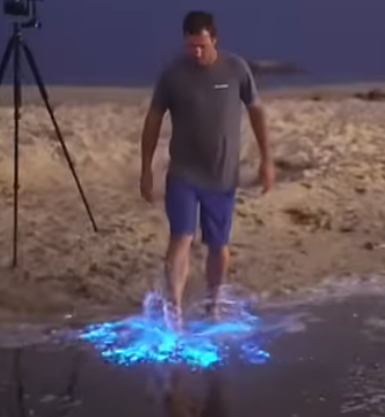
To support student learning, teachers may incorporate a short video or anchoring phenomenon, such as glowing ocean waves, to introduce bioluminescence and spark curiosity. Visual models of the cellular processes involved (e.g., the luciferin–luciferase reaction) can help students better understand the underlying mechanisms. Structured discussion prompts can guide students in comparing cellular adaptations, such as bioluminescence, with behavioral adaptations, such as herding in cattle, thereby reinforcing key concepts across contexts. Additionally, providing students with opportunities to revise and refine their models after analyzing data can deepen their understanding and support the development of more accurate scientific explanations.